
Two shocks in one week show how fragile markets are
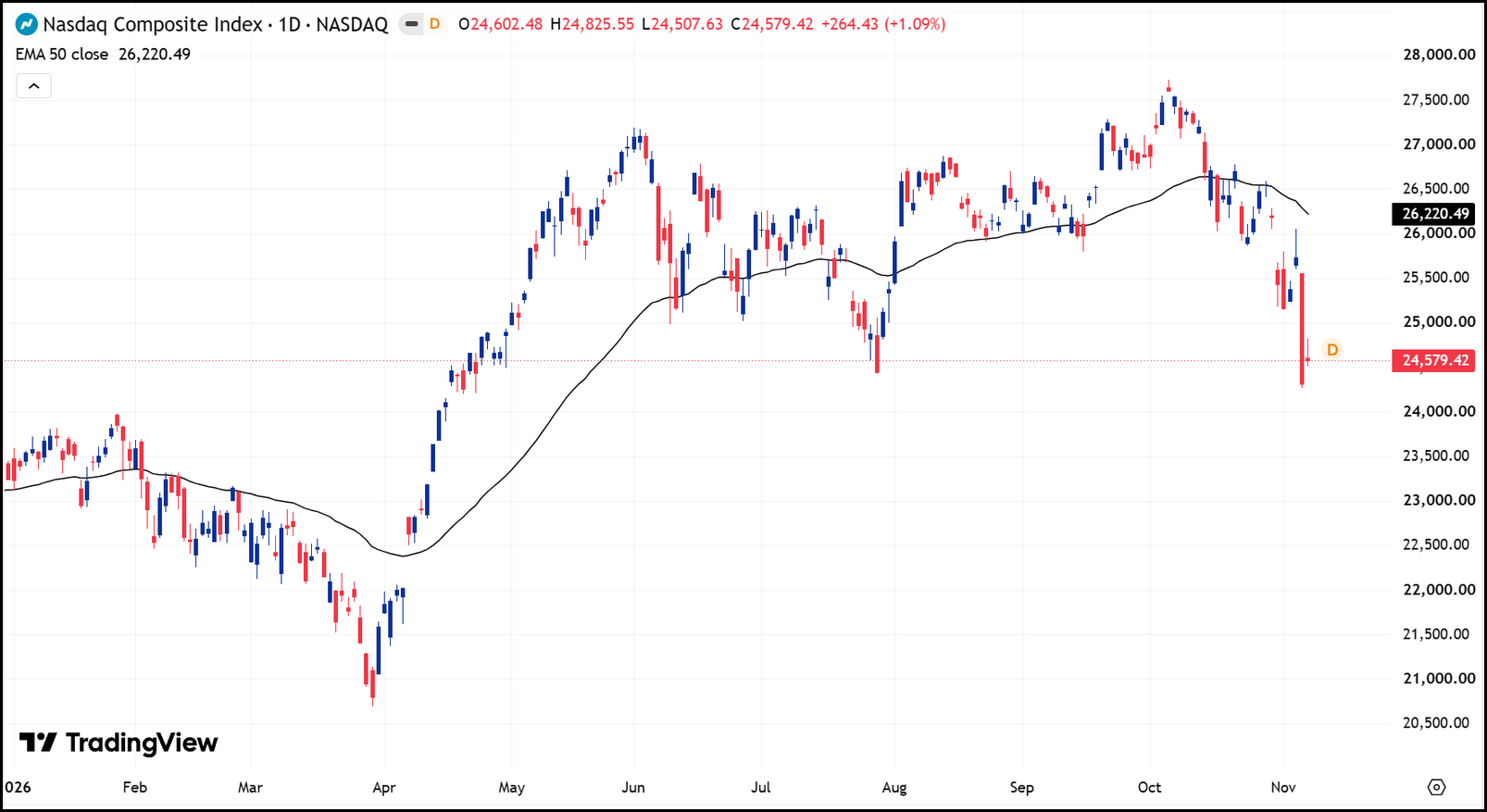
On Thursday 5 November, the Nasdaq Composite fell 5.52% to 24,315, its worst day since the “Liberation Day” tariff shock of April 2025 (Reuters). That left it more than 10% below its 6 October record, officially a correction. The S&P 500 fell 4.36% and the Dow 3.44% (Benzinga). Nvidia lost over 9%, the Philadelphia Semiconductor Index more than 12%, and about US$3 trillion was wiped off S&P 500 companies in a single day (Reuters).
The day before, markets had been celebrating.
From relief to fear in 24 hours
Democrats won both the House and the Senate in Tuesday’s US midterms. The clear result removed fears of a drawn-out dispute, and on Wednesday the Dow jumped 3% (CNBC). Then investors found a new worry. Democrats did well in states pushing back against new data centres, and markets began pricing in tougher rules on the land, power and water those sites need (Reuters). Fewer data centres mean fewer orders for AI chips, so the selling spread from data-centre operators to chipmakers and then to Asia: Samsung Electronics fell 7.5% and SK Hynix 9.5% (Quartz).
An election result alone shouldn’t erase that much value. It did because markets were already on edge. The Nasdaq lost more than US$2.5 trillion in October after Alphabet and Meta failed to convince investors that their AI spending will pay off (Reuters). When most of a year’s gains come from one theme, even a small doubt can drag down the whole market.
The Nasdaq slipped into a correction
A rate rise in London
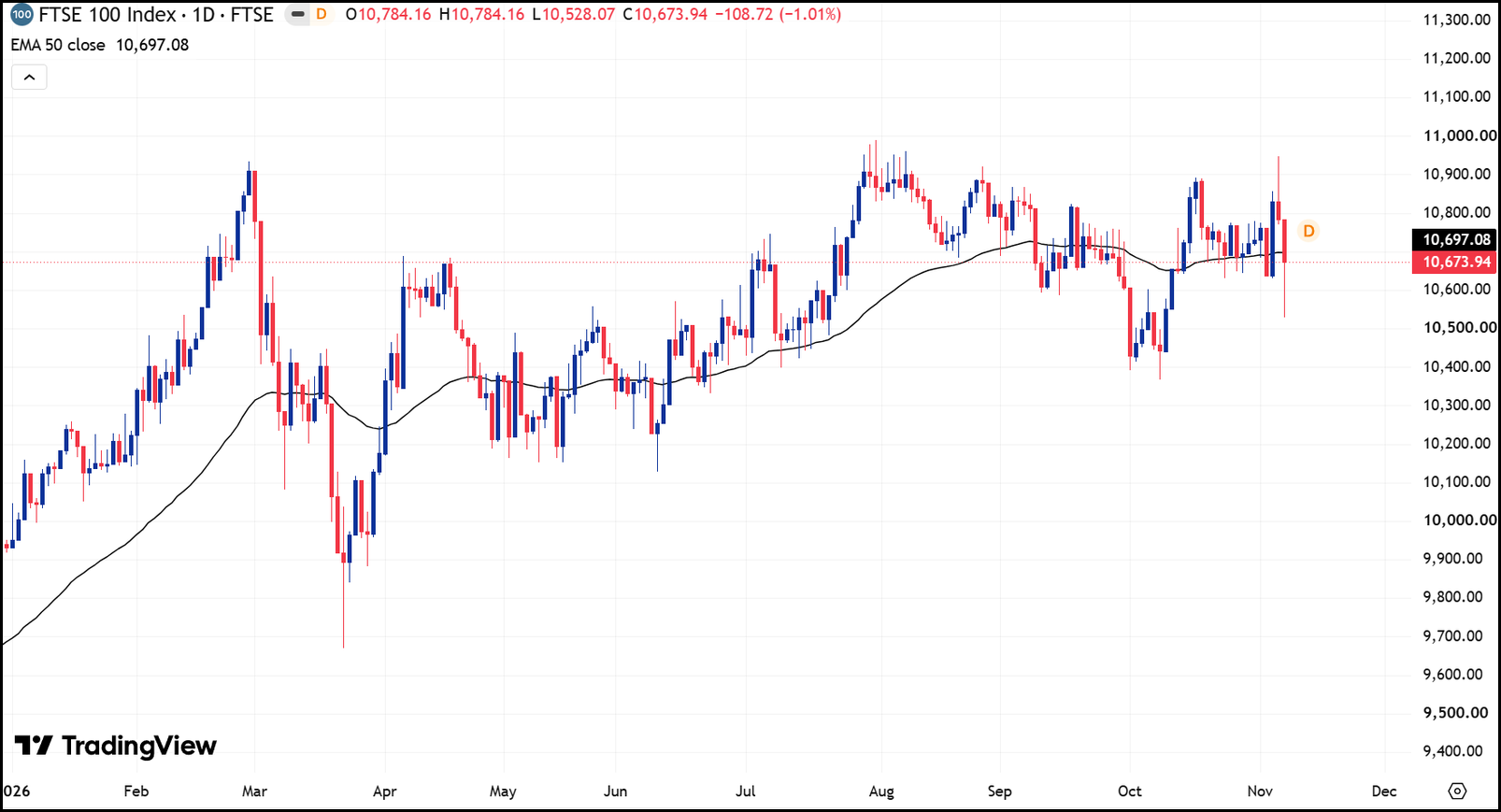
The same day, the Bank of England raised Bank Rate from 3.75% to 4%, its first rise since August 2023. Eight of the nine members voted for a quarter-point rise; Catherine Mann wanted 4.25% (Bank of England). The reason is energy. Conflict in the Middle East has kept prices high, UK inflation was 3.5% in September, and the Bank expects it to approach 5% by mid-2027 (Bank of England). After two years of talk about rate cuts, a major central bank is raising rates again. In London, the FTSE 100 slipped 1.0% on Friday to 10,674, just below its 50-day average (TradingView).
The FTSE 100 slipped back to its 50-day average
Good news that felt like bad news
On Friday, the US reported 165,000 new jobs in October against 65,000 expected, and unemployment fell to 4.1% (US Bureau of Labor Statistics). A strong job market gives the Federal Reserve less reason to cut rates, and adds to fears of a rise. Chip stocks bounced and the Nasdaq closed 1.1% higher at 24,579, but it still lost 3.4% on the week, while the S&P 500 fell 2.7% (AP). Investors moved to safety: the US 10-year Treasury yield ended the week at 4.86%, near its lowest since mid-September, and the yen firmed (Reuters; TradingView).
Our read
The sell-off brought three risks together: stretched valuations in AI stocks, inflation driven by energy prices, and tighter monetary policy. Doubts over data-centre spending threaten demand for chips and the earnings of technology companies. Higher energy prices keep inflation up and make interest-rate cuts harder to justify, and strong US jobs data adds to that pressure. Together, these factors cloud the outlook for company earnings, borrowing costs and share valuations, which is why volatility spread across global markets.
Why it matters for India
India bucked the global sell-off. The Nifty closed at 25,030 on Friday, a nine-month high, after its best week since 2021 (CNBC TV18). With few AI hardware and chip stocks, India was less exposed to the technology-led falls in South Korea and Taiwan. The risks have not gone away, though. If oil climbs again, it could widen India’s current account deficit (the gap between what the country spends abroad and what it earns), weaken the rupee and push up inflation. Higher UK interest rates may also strengthen sterling, raising the rupee cost of anything priced in pounds, from UK travel to study abroad. For the Bristol MEC community, that has direct financial implications.
Reuters, 5–6 November 2026; Benzinga; CNBC, 4 November 2026; Quartz, 5 November 2026; Bank of England, Monetary Policy Summary, 5 November 2026; US Bureau of Labor Statistics, The Employment Situation, October 2026; AP, 6 November 2026; CNBC TV18, 6 November 2026; TradingView.
Published in Edition 01 (Saturday, 7 Nov 2026) on The Marginalia on Substack.