
Why did foreign investors just pour ₹14,796 crore into India?
On Thursday 5 November 2026, foreign portfolio investors (FPIs) bought a net ₹14,796 crore (about US$1.6 bn) of Indian shares, their biggest single-day purchase since February 2021, according to provisional exchange data (Business Standard). The Nifty 50 and Sensex both rose 2.4% on the day (Reuters).
The short answer: three things changed at once. Oil fell, the global trade in AI stocks cracked, and Indian shares began to look like better value after months of foreign selling.
1. Cheaper oil helps India more than most
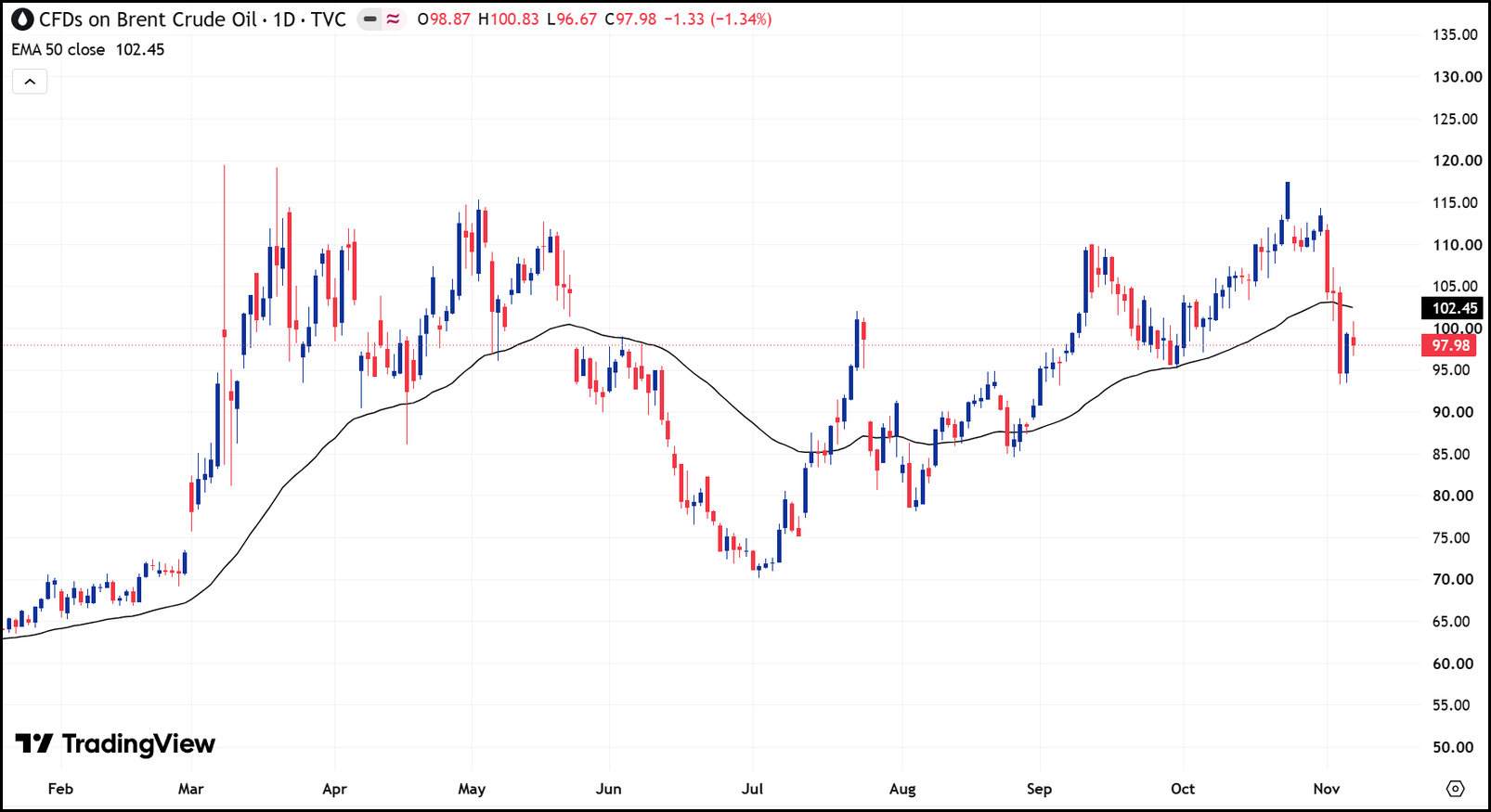
India imports most of the crude oil it uses, so the oil price works like a tax on the economy. Brent crude closed at $117.39 a barrel on 23 October (TradingView), then fell 7.6% on Monday 2 November alone (AP) and ended the week below $100. A lower oil price cuts the import bill, eases inflation, takes pressure off the rupee and lowers costs for companies, all of which make Indian assets more attractive to overseas investors.
Brent crude has fallen sharply from its late-October high
2. Money is rotating out of AI
The buying came as US technology stocks sold off sharply, with the Nasdaq Composite down 5.5% and the S&P 500 down 4.4% that day (Reuters; Benzinga). After months of money crowding into AI-linked companies, investors are reassessing those valuations. India, with a broad economy and little direct exposure to AI hardware, is a natural place to diversify. Investors have not abandoned AI; they are spreading their bets.
3. The numbers behind the move
- ₹14,796 crore: net FPI buying on 5 November, the most since 24 February 2021 (Business Standard).
- ₹45,960 crore: net foreign buying over the full week to 6 November, as the buying continued on Friday (NSE provisional data).
- ₹3.08 lakh crore (about US$32.7 bn): record foreign selling of Indian shares in 2026 up to 12 October, nearly double 2025’s total (Business Standard, NSDL data).
- 2.4%: the gain in both the Nifty 50 and Sensex on 5 November (Reuters).
The February 2021 record included a large promoter-driven block deal (Business Standard). This week’s buying looks broader, which makes it a stronger signal of genuine demand.
The counter-argument: why it may not last
One strong week does not mean the market will keep rising. Oil could climb again if Gulf tensions return. Investors who sold heavily this year can leave just as quickly. Higher US interest rates or a stronger dollar would pull money back out of emerging markets. And valuations still need company earnings to justify them.
Our read
India’s market is not driven by domestic news alone. A move in oil, a sell-off in US tech or a shift in global politics can redirect billions of dollars within days. For companies, that affects funding and investor confidence. For investors, it is a reminder to look at the bigger picture rather than react to one day’s move. Money does not move randomly: it moves towards value and changing expectations.
The question for readers: if foreign investors can pull billions out of India and return within days, how much should India’s markets rely on foreign capital?
Business Standard, 5–6 November 2026 and 13 October 2026 (NSDL data); Reuters, 5 November 2026; Benzinga, 6 November 2026; AP, 2 November 2026; NSE provisional data; TradingView.
Published in Edition 01 (Saturday, 7 Nov 2026) on The Marginalia on Substack.