Nvidia’s founder exits just as its AI business hits new highs
How it started
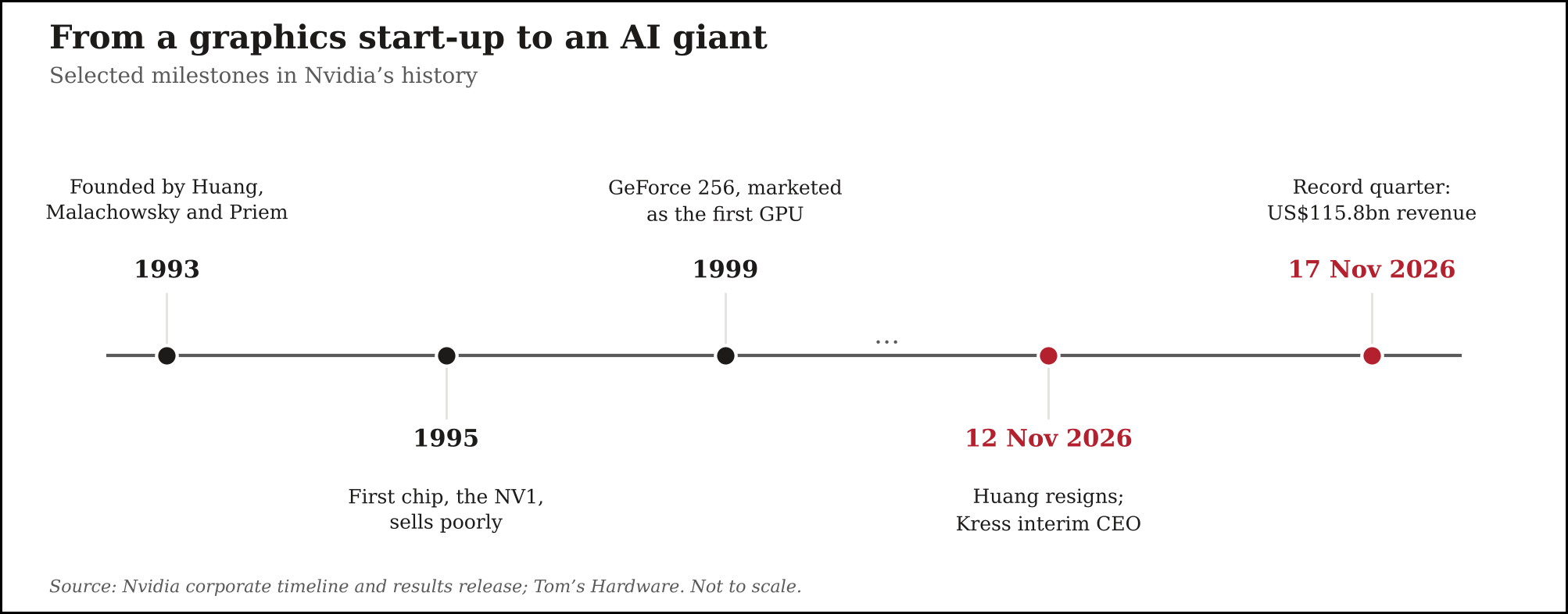
Nvidia was founded in April 1993 by Jensen Huang, Chris Malachowsky and Curtis Priem, who planned the company over meals at a Denny’s diner in San Jose (Nvidia). Their aim was to make computer graphics faster, especially for video games, by building chips that could handle the heavy maths behind 3D images. The first product, the NV1, launched in 1995 and sold poorly, leaving the young company short of cash. Rather than give up, Nvidia changed course. In 1999 it launched the GeForce 256, which it marketed as the world’s first GPU (graphics processing unit) (Nvidia).
How it makes money
A GPU’s strength is doing thousands of calculations at once. That made it useful well beyond gaming, in scientific computing and, above all, in training and running AI models. Nvidia now sells a full platform: chips, complete server systems, networking equipment and software such as CUDA, the toolkit developers use to write programs for its chips. That software matters. Once developers build on CUDA, switching to a rival’s chips becomes costly, which helps Nvidia keep both its customers and its high margins.
The latest results
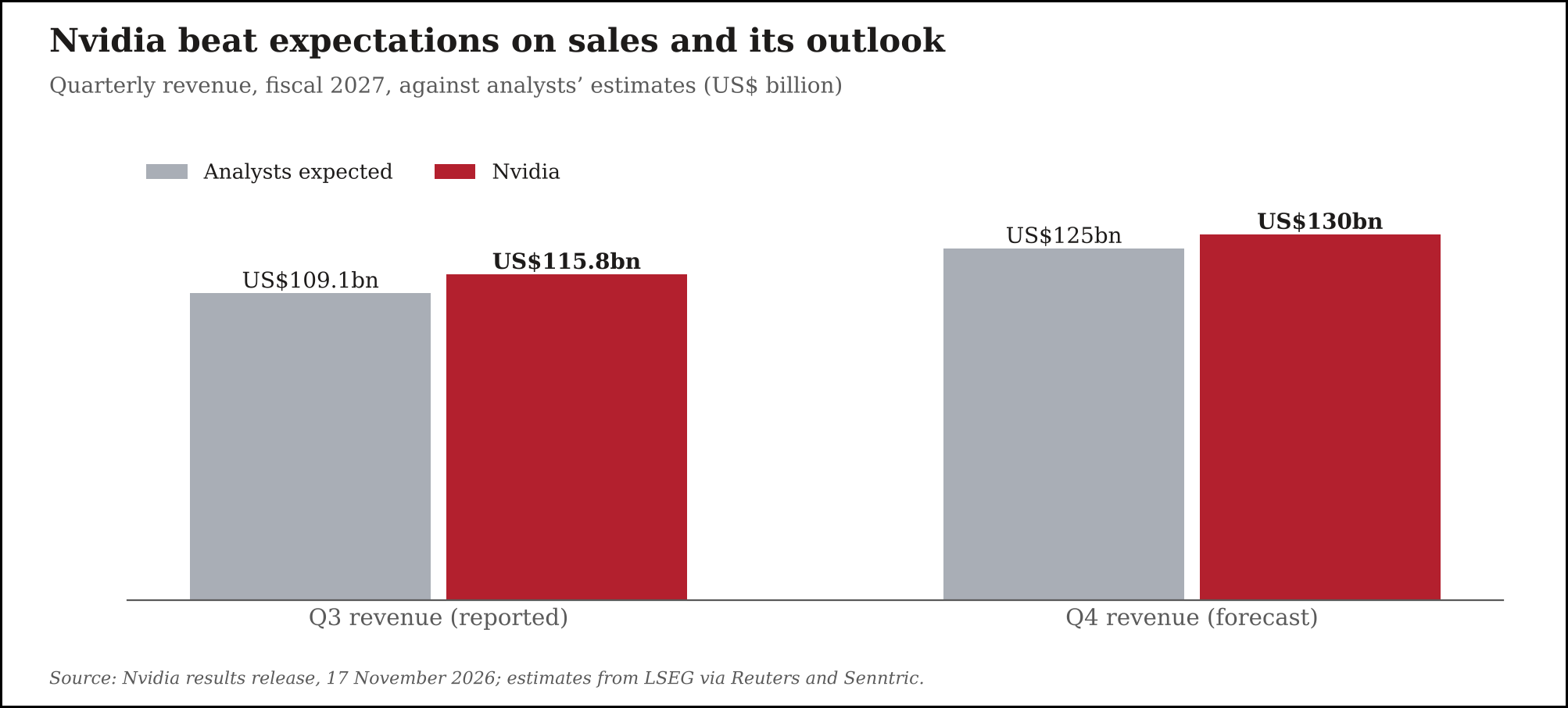
In the third quarter of fiscal 2027 (the three months to 25 October 2026), revenue rose 103% year on year to US$115.8 billion, and 20% on the previous quarter. Data-centre revenue, mostly AI chips and systems, made up US$107.6 billion of that, up 110% (Nvidia). Gross margin was 74.8%, meaning Nvidia kept about 75 cents of every dollar of revenue after production costs. It expects about US$130 billion in revenue next quarter, although that figure includes an extra week and assumes no data-centre chip sales to China (Nvidia).
The leadership crisis
The results came days after the biggest leadership change in Nvidia’s 33-year history. On 12 November, the board announced that Huang had resigned as president, CEO and director, effective immediately. Chief financial officer Colette Kress is serving as interim CEO, Harvey Jones became the board’s first chair, and the search for a permanent CEO is under way (Nvidia). The announcement gave no reason for Huang’s departure.
It followed weeks of reports. The New York Times reported that US intelligence suspected a businesswoman with whom Huang had a personal relationship, a former executive at the Singapore-based data-centre company Megaspeed, of spying for China. Huang told employees on 8 November that he had been unfaithful to his wife, and the board opened an independent investigation. China’s foreign ministry dismissed the spying claim as “groundless” (South China Morning Post), and Nvidia’s board said it had no reason to believe national security or company secrets had been compromised (PBS NewsHour, citing The New York Times). No charges have been filed. These remain allegations, not findings.
The risks
- Leadership: Huang co-founded the company and ran it for 33 years. Investors will now judge whether its strategy and customer relationships hold up without him.
- Regulation: the episode sits close to US export controls on AI chips to China, a market Nvidia already leaves out of its forecasts.
- Competition and spending: rival chips from AMD and custom chips built by large cloud companies are gaining ground, and recent doubts about AI data-centre spending have already hit chip stocks.
Our read
Nvidia’s story shows how a company can survive an early failure and reinvent itself, turning gaming chips into the engine of the AI boom. Its numbers are as strong as they have ever been. But this month is a reminder that strong earnings do not remove governance, reputational or regulatory risk. A company whose identity is built around one founder needs a clear succession plan, and Nvidia’s next few quarters will test whether its value rests on its business rather than on one person.
Nvidia, corporate timeline; Nvidia, “NVIDIA Announces CEO Transition”, 12 November 2026; Nvidia, results for the third quarter of fiscal 2027, 17 November 2026; LSEG estimates via Reuters, 17 November 2026; Senntric; PBS NewsHour, November 2026, citing The New York Times; South China Morning Post; Tom’s Hardware.
Published in Edition 02 (Sunday, 22 Nov 2026) on The Marginalia on Substack.