Machines now drive most trading on the NSE
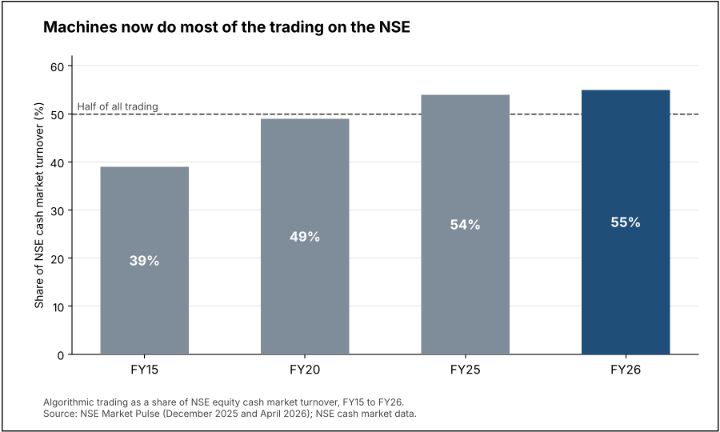
On 20 November the NSE told brokers to stop giving most retail clients a key tool for running trading bots, with immediate effect. To see why that matters, it helps to know how much of the market is now run by machines. Algorithms made up 55% of turnover in the NSE’s cash market in FY26, up from 39% in FY15 (NSE Market Pulse). In equity derivatives the share is about two-thirds (NSE Market Pulse, via QuantInsti). So how does a machine actually trade?
From idea to order
Algorithmic trading, or algo trading, simply means a computer places orders automatically when conditions set in advance are met. Every algo starts as a rule that a person writes. A simple one might be: buy 100 shares when the price climbs above its 50-day average and sell when it drops back below. The trader then tests that rule on years of past prices. This is called backtesting, and it shows how the rule would have done before any real money is at risk. If the results hold up, the rule is turned into code. The code connects to a broker through an API (application programming interface), a channel that lets one piece of software send instructions to another. The broker only accepts these orders from a fixed internet address registered in advance, called a static IP. The program watches live prices and, when its conditions are met, sends an order to the broker, who passes it on to the exchange. The exchange runs its own risk checks before the order reaches the market. The whole trip can take a fraction of a second.
Not all algos do the same job
Big funds use algos to break one large order into hundreds of small ones, so they don’t push the price against themselves. Market makers use them to keep quoting buy and sell prices all day. At the fastest end is high-frequency trading, where firms put their servers inside the exchange’s own data centre to save microseconds on every trade. This is called colocation, and it accounted for a record 39.4% of NSE cash market turnover in FY26 (NSE Market Pulse).
The rules, and this week’s change
SEBI’s framework for retail algo trading, set out in February 2025, has applied to every stockbroker since 1 April 2026. Each algo order carries an exchange-issued ID, so it can be traced back to its strategy. Retail traders who send more than 10 orders a second on an exchange have to register their algo. Brokers are responsible for every algo on their platform, and firms selling ready-made strategies must be approved by the exchange. Those whose logic is hidden from users, known as black-box algos, must also register with SEBI as research analysts (Tradejini).
The NSE’s new circular goes further. Only “tech-savvy” retail investors, meaning people who write their own algorithms, can now get static IP access. Everyone else has to use approved providers whose strategies run on the broker’s own servers. Brokers that skip the required paperwork face a fine of ₹5,000 per client. The NSE said it acted after complaints that some approved providers were misusing static IPs. Retail algo traders also have to accept that they can’t use the exchange’s complaints process if their algorithm loses money (MediaNama).
Our read
Algos help keep markets liquid, which means there is usually someone ready to buy or sell. But speed is an edge, and it mostly belongs to big players. A SEBI study released on 20 August found that 87.7% of individual F&O traders lost money in FY26, a combined ₹91,685 crore (SEBI, via Business Today). About 99% of the profits made by proprietary trading firms and foreign investors came from entities that used algorithms (SEBI, via Open). That is why the rules keep getting tighter. A bot can follow a rule faster than you can, but it can’t turn a bad rule into a good one, and it won’t put you on the same footing as a firm with servers inside the exchange.
Sources: NSE circular, 20 November 2026, via MediaNama, 24 November 2026; NSE Market Pulse (December 2025 and April 2026); QuantInsti; Multibagg, 23 September 2026; Tradejini; SEBI, study on profitability of individual traders in equity derivatives, 20 August 2026; Business Today, 21 August 2026; Open, 20 August 2026.
Published in Edition 03 (Sunday, 29 Nov 2026) on The Marginalia on Substack.