Titan: the business behind India’s jewellery obsession
A jewellery retailer built on trust is turning that trust into a competitive advantage.
When Indians buy jewellery, they are rarely buying just gold. They are buying trust, tradition, status and the reassurance that a big purchase is worth what they paid. Titan understood this long before branded jewellery became a major force in Indian retail, and built a business around turning that trust into a brand that could grow.
The origin story: from watches to a lifestyle company
Titan was founded in 1984 as a joint venture between the Tata Group and the Tamil Nadu Industrial Development Corporation (TIDCO). Its ambition was simple but bold: make world-class watches in India and put them within reach of Indian consumers, at a time when choice was limited (Titan). Its watches reached the market in 1987, made at a new factory in Hosur, Tamil Nadu (Titan; Tata). Rather than treat watches as purely functional, Titan sold them as expressions of style and identity.
Its most important move came in the mid-1990s, when it entered jewellery with Tanishq. This was a market where trust, purity and relationships with local jewellers mattered deeply. Tanishq set itself apart through transparency, design and quality checks; in 1997 it introduced the Karatmeter, which lets customers test the purity of their gold in store (Tata). Jewellery went on to become the company’s biggest growth engine.
Titan kept widening its range: Fastrack for younger buyers, Titan Eye+ in eyewear (2007), Zoya in luxury jewellery (2009), Mia for everyday jewellery (2011) and CaratLane for online and omnichannel sales (Titan). What began as a watchmaker is now a multi-category lifestyle company.
Follow the money
Jewellery is Titan’s biggest revenue engine. In Q2 FY27 (July–September 2026), total income rose 25% to ₹20,533 crore, excluding bullion and digital-gold sales (Titan). Jewellery brought in ₹17,495 crore, up 24.1% year on year, about 85% of the total. Watches earned ₹1,881 crore, up 27.4%, and EyeCare ₹281 crore, up 27.7% (Titan Q2 FY27 investor presentation). Profit after tax, excluding a one-off fair-value gain, rose 54% to ₹1,722 crore (Titan).
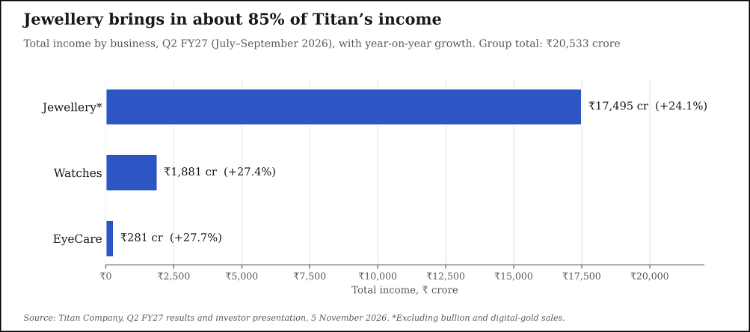
These numbers reveal more than growth. Selling higher-value pieces, adding more diamond-studded jewellery to the mix and opening more stores can all lift profits beyond the effect of gold prices alone.
Gold, however, complicates the story. When gold prices rise, reported sales can increase even if Titan sells no more pieces. Investors therefore need to separate price-led growth from genuine growth in volumes and changes in product mix.
The moat: trust at scale
Titan’s advantage is hard to copy quickly. Its brands, store network, sourcing relationships and reputation have been built over decades. Its several brands let it reach customers at different price points and occasions, from everyday pieces to luxury purchases. Its gold sourcing adds a second layer. Titan leases gold from bullion banks rather than buying it outright, which limits its exposure to price swings (Reuters, via ThePrint). Its exchange programme, which accepts old gold from any jeweller, now drives about half of Tanishq’s sales (Business Today; The Hindu BusinessLine), keeping customers coming back.
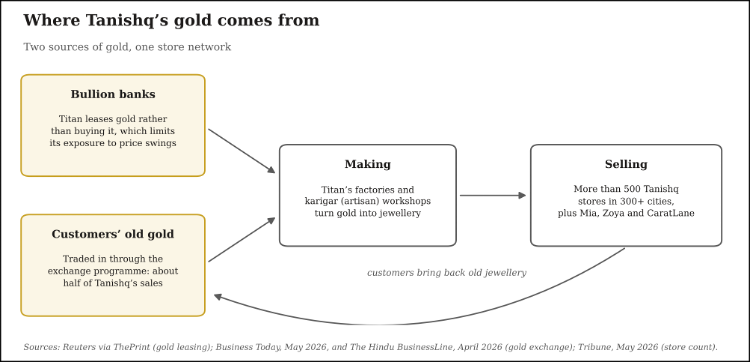
Yet the moat is not invincible. Regional jewellers remain formidable competitors, often offering flexibility, local relationships and sharper prices. Titan must keep proving that its brand premium is worth paying.
What could go wrong?
- Gold prices: sharp swings can hurt demand and make reported growth harder to read.
- Affordability: high gold prices push some buyers towards lighter or cheaper pieces.
- Competition: regional chains and local jewellers compete hard on price and relationships.
- Execution: rapid expansion needs heavy investment in stores, inventory and working capital.
- Valuation: even if the business keeps performing, an expensive share price can limit returns if growth falls short of expectations.
Our read
Titan’s long-term opportunity is not simply rising gold consumption. It is the shift from unorganised jewellery shops towards branded, trusted players, and Titan is well placed to benefit. The central investment question is whether that future growth is already reflected in its share price. The takeaway: a great brand can turn trust into pricing power, but even the strongest business still has a price.
Sources: Titan Company, Q2 FY27 results and investor presentation, 5 November 2026; Titan, “Our heritage”; Tata Group newsroom; Reuters via ThePrint; Business Today, 27 May 2026; The Hindu BusinessLine, 19 April 2026; Tribune, 28 May 2026.
Bull vs Bear
Case for the moat
- Brand trust built on Tanishq’s Karatmeter purity checks spans price points via Zoya, Mia, and CaratLane.
- Accepting old gold from any jeweller generates roughly 50% of Tanishq’s sales while bullion-bank gold leases dampen metal swings.
- Q2 FY27 income expanded 25% YoY to ₹20,533 crore with adjusted profit after tax up 54% to ₹1,722 crore.
Key risks
- Sharp swings in gold prices complicate headline revenue growth and shift demand toward lighter, lower-ticket pieces.
- Regional and local jewellers compete aggressively on flexibility, making charges, and personal trust.
- Rapid store rollout demands heavy inventory and working capital at an already demanding valuation.
Published in Edition 03 (Sunday, 29 Nov 2026) on The Marginalia on Substack.