The UK gilt crisis of 2022
What happened
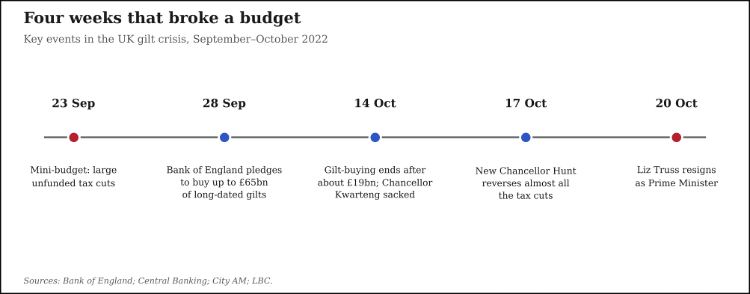
On Friday 23 September 2022, Britain’s government announced a “mini-budget” promising tens of billions of pounds in tax cuts that were not backed by matching funding (Central Banking). Markets reacted badly. Investors dumped UK government bonds, known as gilts, and their yields jumped. The Bank of England later said the days that followed saw the five biggest daily moves ever recorded in the 30-year inflation-linked gilt, in data going back to 2000 (City AM). By 28 September the Bank had to step in, promising to buy up to £65 billion of gilts over a two-week window (Central Banking).
Why it happened
The tax plan lit the fuse, but pension funds supplied the fuel. Many had used leveraged strategies called liability-driven investment, or LDI (Central Banking). When gilt prices fell, these funds had to put up extra collateral. To raise the cash, they sold assets, mostly gilts, which pushed prices down and yields up (Tony Blair Institute for Global Change). That created even more collateral calls. Analysts feared a “doom loop” in which forced selling would feed on itself (ICAEW). A Bank of England deputy governor later wrote that LDI managers had warned that several funds were likely to go under at the yields then on screen (LBC).
What it cost
Gilts had their worst month of any major government bond market in more than 60 years (ICAEW). The stakes were enormous, because LDI funds held around £1 trillion in long-dated gilts (City AM). Oddly, the rescue turned out smaller than advertised. The Bank bought only about £19 billion of its £65 billion limit (Central Banking), which suggests the promise itself did most of the calming. Yields also eased once the new chancellor scrapped almost everything in the mini-budget (City AM). What was harder to repair was the UK’s reputation for fiscal discipline.
Then and now
Four years on, the scar is still visible. In October 2026 the Institute for Fiscal Studies (IFS) noted that UK borrowing costs have kept rising and that the bond market still views the UK partly through the lens of 2022 (IFS). Yet Chancellor John Healey’s first Budget on 28 October passed without drama: 10-year gilt yields fell towards 5.3% after it reaffirmed fiscal discipline (Trading Economics).
Our read
Some things are different this time. The IFS argues that the risk of a home-grown gilt crisis has fallen, and that bigger threats now come from international markets (IFS). The Bank has also stepped up its communication with pension funds and their regulators (Central Banking). But the basic lesson has not changed. Bond markets will punish a government whose plans look unfunded, and the real danger often sits in places most investors never think to check.
Sources: Central Banking, 2022; City AM, 2022; ICAEW, 21 October 2022; LBC, 6 October 2022; Tony Blair Institute for Global Change, 2022; Institute for Fiscal Studies, 12 October 2026; Trading Economics, 28–29 October 2026.
Published in Edition 03 (Sunday, 29 Nov 2026) on The Marginalia on Substack.