Washington targets 14 economies while Britain braces for winter bills
On Wednesday 25 November the Office of the US Trade Representative (USTR) proposed new tariffs on 14 economies, including China, the European Union, Japan and India. The duties come out of a Section 301 investigation, a US trade law that lets Washington act against trade practices it sees as unfair. This time the complaint is “structural excess capacity”: countries make far more than they can sell at home and export the surplus cheaply (USTR, via Kelley Drye). The UK was not among the 16 economies investigated. The same day, Ofgem said the UK energy price cap will rise 26% from 1 January to 31 March 2027, taking a typical household’s yearly bill from £1,723 to £2,166, or from about ₹2.1 lakh to ₹2.6 lakh. Ofgem blamed the conflict in the Middle East for pushing up international gas prices (Ofgem, via Reuters).
What the US is proposing
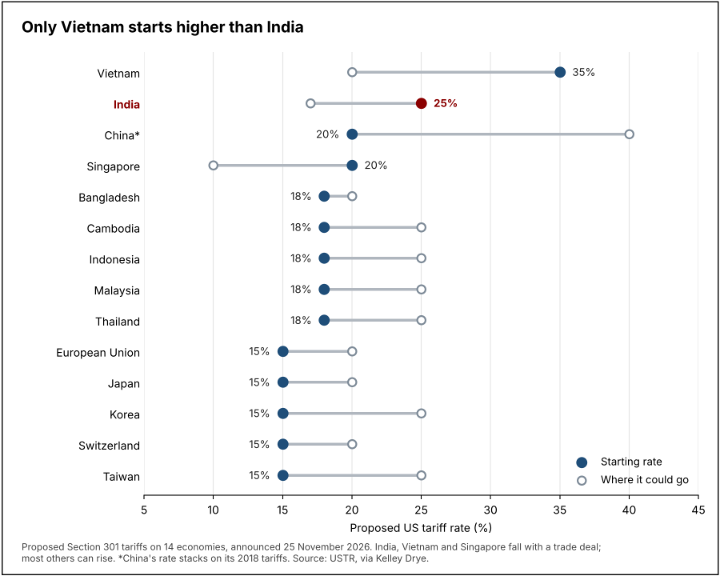
The rates differ by country and most could still move. The EU and Japan start at 15%, matching the ceiling they agreed with Washington, but could rise to 20%. China faces 20% on top of the tariffs it has paid since 2018, rising to 40% if it does not address US concerns (Kelley Drye); separately, its trade truce with the US expires on 10 January (Reuters). Vietnam starts highest at 35%. India comes next at 25%, which would drop to 17% if the two countries sign a trade deal. Comments are due by 5 January 2027 and a public hearing starts on 25 January, so nothing takes effect before then (Kelley Drye). The pushback was quick. China’s commerce ministry called the move “an act of unilateralism” and said it reserves the right to respond; Japan said it has no excess capacity; and the EU’s trade commissioner said Washington must respect the 15% ceiling (AFP and Reuters, via France 24).
The UK’s problem is closer to home
Avoiding US tariffs does not help much if energy bills jump. The cap covers about 20 million households on standard tariffs. Another 10 million on fixed deals are protected until those deals end, and the government will give households £100 towards their bills from January (Ofgem). Higher energy prices push inflation up, so markets now see more than an 80% chance that the Bank of England raises rates on 17 December. They also squeeze household spending. The pound hit its weakest level since April 2025 on Monday, at about $1.30, mostly because the dollar strengthened, and was trading around $1.31 by Thursday (TradingNews).
Also this week: Wall Street bounces back
- A relief rally. After their worst week since 2020, US shares rebounded as investors bought beaten-down AI stocks. The Nasdaq rose 6.7%, the S&P 500 5.6% and the Dow 5.5%; the FTSE 100 gained 3.4% (TradingView; Marketcalls).
- Huang is back. On 23 November Nvidia’s board reinstated Jensen Huang as CEO, 11 days after his resignation, saying it was satisfied with his candour and ability to lead. Colette Kress returns to her role as finance chief (Nvidia, filing with the SEC). Our Edition 2 Business story covered his exit.
- Doubts remain. Investors are still weighing soaring AI costs, heavy borrowing and uncertain returns on investment, so the rebound may prove fragile.
What to watch, 30 November to 4 December
- UK mortgage approvals from the Bank of England and Nationwide’s house price index, for signs that buyers are pulling back before bills rise.
- UK manufacturing PMI on Tuesday 1 December and services PMI on Thursday 3 December, especially export orders (S&P Global).
- Whether Beijing or Brussels moves from statements to actual countermeasures.
- Any progress on a US–India trade deal, which decides whether India pays 25% or 17%.
Our read: why it matters for India
India is one of the hardest hit. Only Vietnam faces a higher starting rate, though China’s 20% comes on top of older tariffs. The rupee felt it straight away: on 26 November it fell 20 paise to 92.40 against the dollar in early trade, as the tariff news landed just as Brent crude rose to $95.34 a barrel (PTI, via Free Press Journal). The quickest way out is a trade deal with Washington that brings the rate down to 17%. The UK offers some cushion. India’s trade deal with Britain, known as CETA, came into force on 15 July 2026 and gives 99% of Indian exports duty-free access to the UK (All India Radio; Business Today). It cannot replace the US market, but it gives exporters another place to sell if talks with Washington stall.
Sources: USTR, via Kelley Drye, November 2026; Reuters via Investing.com, 25 November 2026; AFP and Reuters via France 24, summarised by The Company Chronicle, 26 November 2026; Ofgem, via Reuters on TradingView, 25 November 2026; TradingNews, 26 November 2026; PTI, via Free Press Journal, 26 November 2026; All India Radio, 15 July 2026; Business Today, 18 June 2026; Nvidia, Form 8-K filed with the SEC, 23 November 2026; TradingView; Marketcalls.
Published in Edition 03 (Sunday, 29 Nov 2026) on The Marginalia on Substack.